SAGA designs and supplies high-performance lapping and polishing machines, precision tooling, and engineered components used in controlled surface finishing applications across optics, advanced materials, and high-tolerance manufacturing industries.
We work alongside experienced engineering partners to support complete lapping and polishing systems aligned with customer production goals.
Lapping and Polishing Tooling
Functional Engineering Objectives
The primary engineering objectives of lapping and polishing systems include:
• Achievement of flatness and parallelism
• Control of surface roughness parameters (Ra, Rz, PV)
• Minimisation of subsurface damage
• Dimensional stability under thermal and mechanical loading
• Repeatability across production cycles
These objectives are achieved through controlled interaction between the plate surface, abrasive media, slurry chemistry, applied pressure, and kinematic motion.
Plate Material Selection Criteria
Plate materials are selected based on:
• Hardness relationship to workpiece material
• Chemical compatibility with slurry constituents
• Wear behaviour and conditioning response
• Thermal stability
• Risk of contamination transfer
These objectives are achieved through controlled interaction between the plate surface, abrasive media, slurry chemistry, applied pressure, and kinematic motion.
Cast Iron
Micro-graphitic cast iron enables controlled abrasive embedding and predictable wear behaviour.
Characteristics
• Moderate hardness with self-conditioning capability
• High dimensional stability
• Consistent material removal performance
Applications
• Engineering metals
• Carbides
• Technical ceramics where metallic contamination is not critical
Hardened Steel
Used for aggressive stock removal applications requiring high structural durability.
Engineering Limitation
• Reduced abrasive retention
• Higher micro-scratch risk
Aluminum
Used primarily as a substrate for compliant polishing pads.
Characteristics
• Low hardness
• High machinability
• Corrosion sensitivity
Stainless Steel
Selected when chemical resistance is required.
Trade-off
• Higher cost
• Lower abrasive embedding capability
Ceramic Plates
Used to eliminate metallic contamination risks.
Benefits
• Chemical inertness
• Stable surface chemistry
• No ferrous impregnation
Glass Plates
Used for ultra-delicate substrates.
Characteristics
• Minimal contamination risk
• High fragility
• Low hardness
Natural Metals (copper, Tin, Tin-Alloys)
Used mainly for fine diamond polishing.
Function
• Facilitate diamond particle retention
• Enable ultra-fine surface finishes
Composite Plate Materials
Engineered matrices designed to balance removal rate, surface finish, and wear stability.
Groove and Surface Conditioning Function
Groove geometrics govern:
• Slurry hydrodynamics
• Contact mechanics
• Swarf evacuation
• Local pressure distribution
• Thermal dissipation
Improper groove design leads to hydroplaning, glazing, non-uniform wear, and unstable removal behaviour.
Groove Pattern Classifications
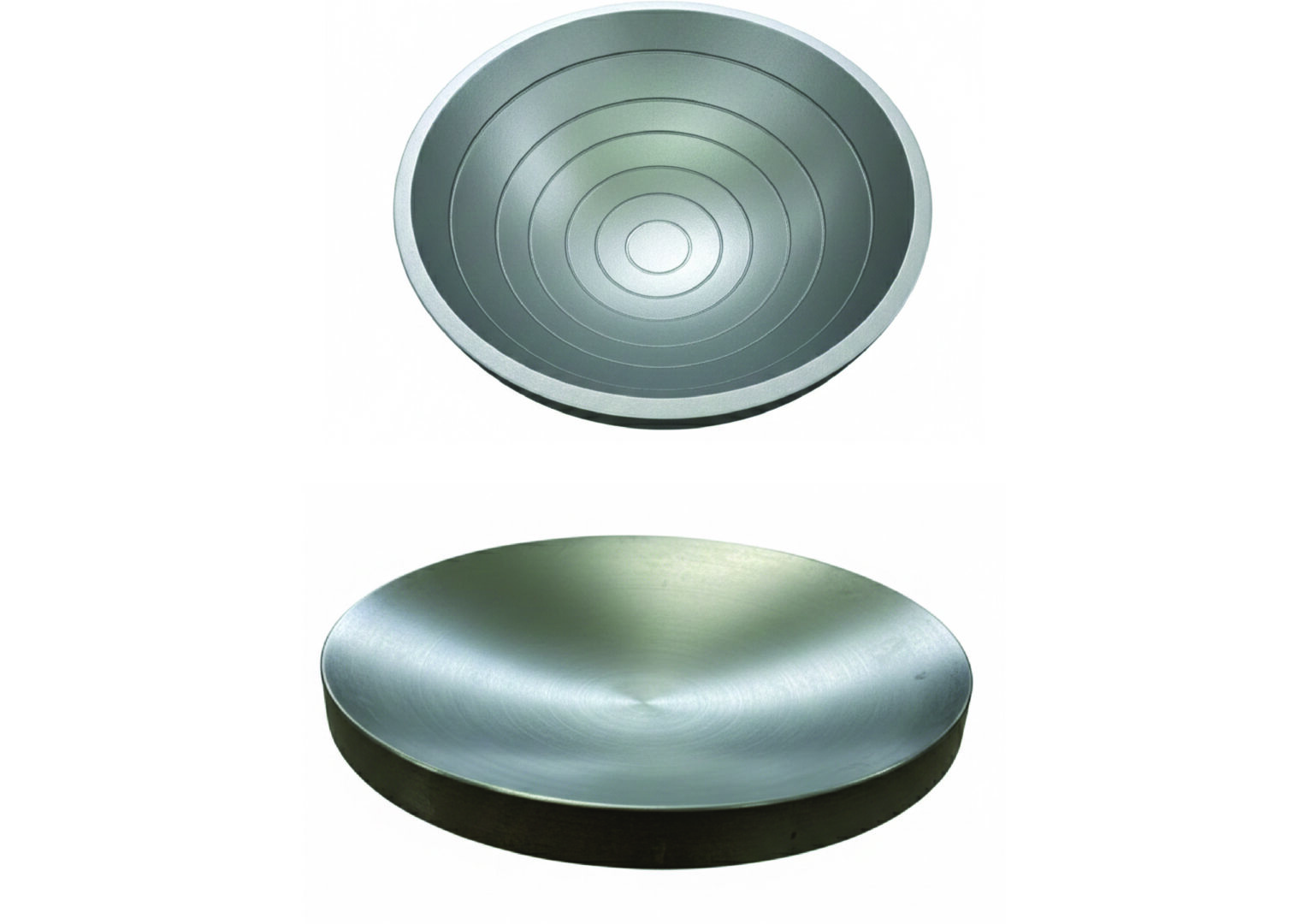
Solid Plates
Provide maximum support area and uniform pressure distribution.
Limitation
Reduced slurry transport efficiency.
Radial Grooves
Provide balanced slurry transport and manufacturability.
Performance
Stable wear patterns
Predictable removal rates
High process repeatability
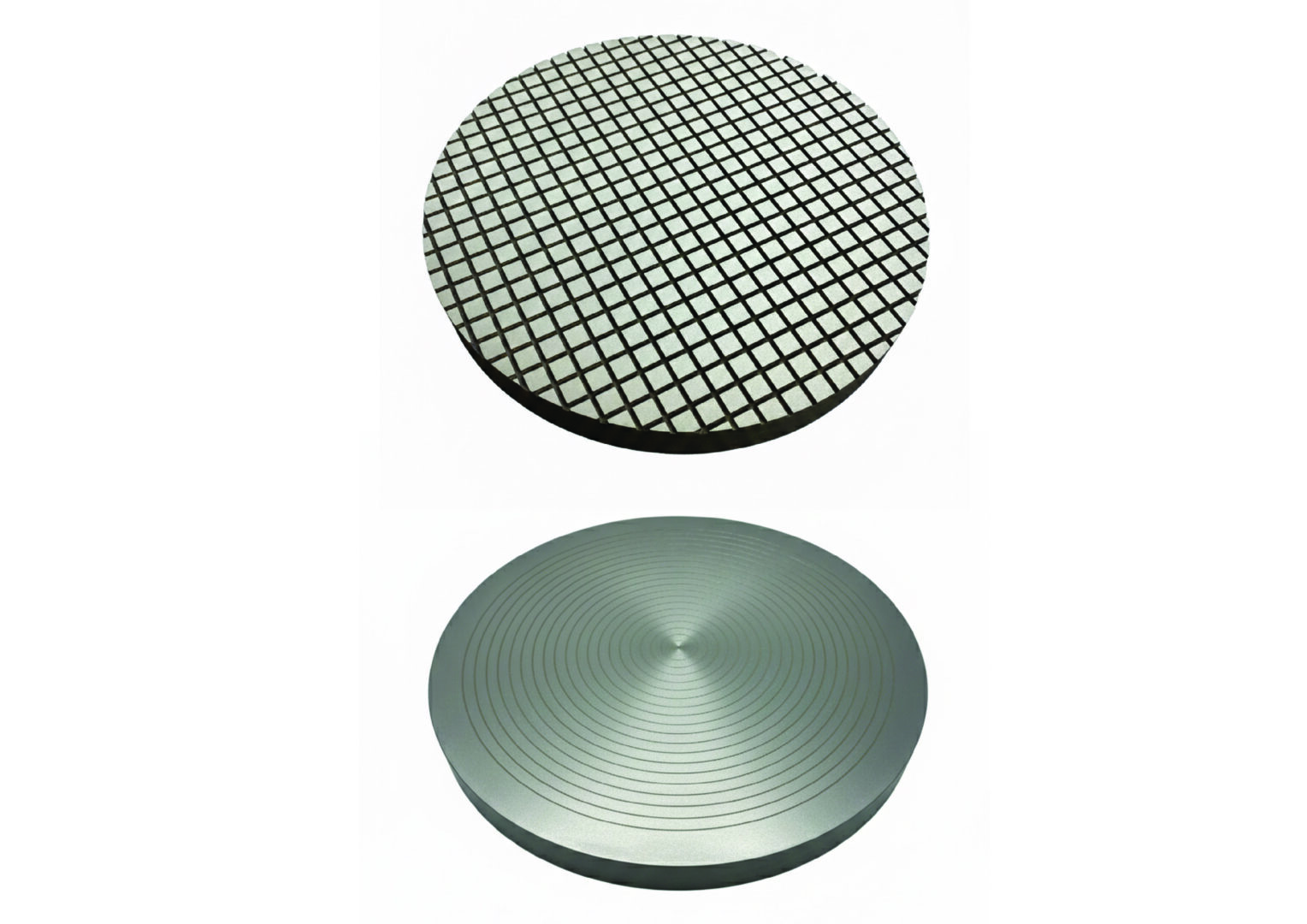
Cross-Grid (waffle) Grooves
Increase slurry retention and contact modulation.
Risk
Groove intersection breakdown may generate scratch defects.
Spiral Grooves
Optimise slurry transport and swarf evacuation.
Constraint
Higher stress concentration at part edges.
Concentric Grooves
Used in low-speed, high-lubricity processes.
Limitation
Limited compatibility with automated carrier systems.
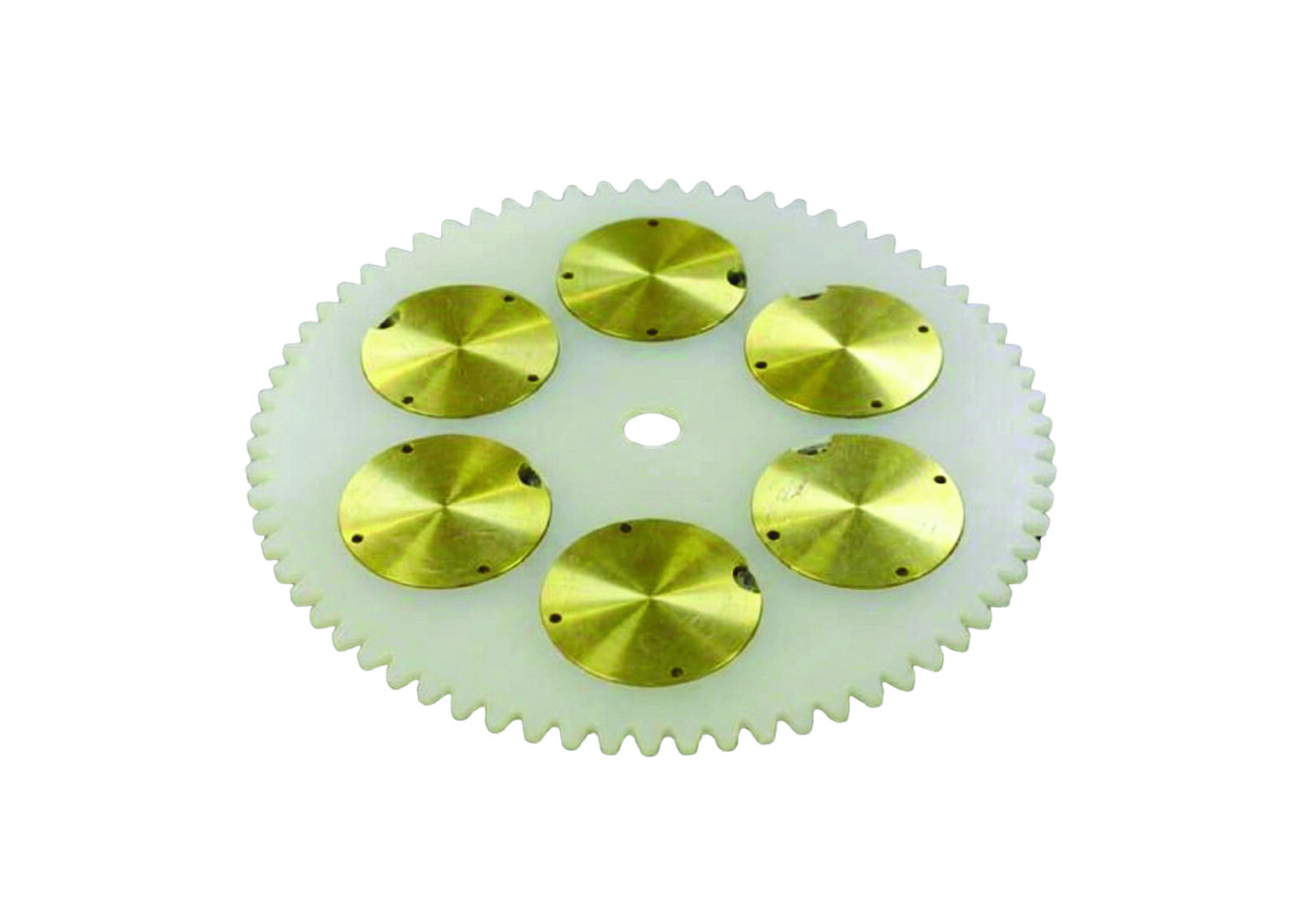
Insert Carriers (Polishing Carriers)
Insert carriers are precision holding systems designed to support thin, brittle, or high-value substrates during lapping and polishing operations. They combine rigid metallic carrier frames with compliant insert materials to optimise contact mechanics, part stability, and edge protection.
Functional Role
Insert carriers:
• Reduce edge stress concentration
• Improve thickness uniformity
• Stabilise rotational kinematics
• Improve material removal repeatability
• Reduce wafer edge fracture and chipping
Mechanical Principle
The compliant insert layer distributes contact pressure while the steel frame maintains dimensional rigidity. This hybrid structure enables:
Controlled elastic deformation
Reduced shear stress at part edges
Improved centering stability
Construction
Typical construction includes:
• Precision-machined steel carrier frame
• Polymer or composite insert segments
• Bonded or mechanically retained interfaces
• Insert hardness is selected based on:
• Substrate brittleness
• Process pressure
• Abrasive aggressiveness
• Target surface finish
These objectives are achieved through controlled interaction between the plate surface, abrasive media, slurry chemistry, applied pressure, and kinematic motion.
Need expert
guidance?
Talk to our engineering team to evaluate your finishing challenges, propose custom solutions, and help you get more from your equipment.
Precision surface finishing machines and services since 1948. Engineering solutions that deliver consistent, repeatable results at the micron level.